
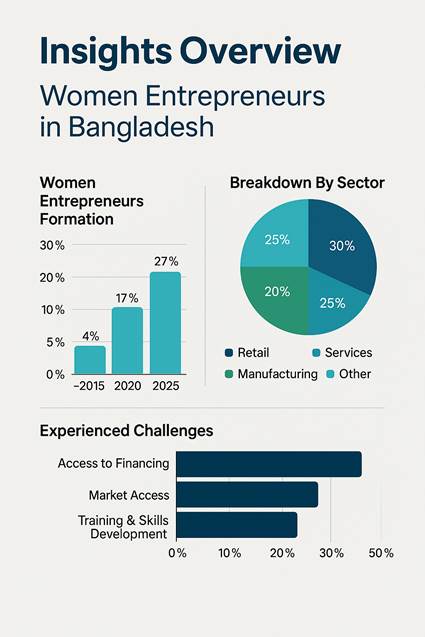
November 2025 painted a vivid picture of how women entrepreneurs in Bangladesh continue to rise, rebuild, and reshape the nation’s economic rhythm. The month was marked by new training programmers, stronger digital adoption, and growing calls for structural reforms—showing that women-led enterprises are no longer a side story, but a central force in the country’s entrepreneurial landscape.
SECTION 1: GROWING MOMENTUM NATIONWIDE
Across the country, November witnessed a significant acceleration in women-led enterprises, particularly in regions like Barishal and Chattogram. Local support from development agencies—such as BSCIC—helped more than 300 women become self-reliant through online and micro-enterprises. These initiatives together generated an estimated market size of Tk 2.5 crore, demonstrating how grassroots entrepreneurship is becoming an economic pillar.
Banks also stepped in boldly. Prime Bank PLC held a major Women Entrepreneurs Training & Development Programme in Chattogram, targeting financial literacy, business planning, and SME-readiness. These institutional efforts signal that women-led businesses are finally being seen as strategic investments rather than goodwill projects.
SECTION 2: STRENGTHENING EXPORT READINESS
A major highlight of the month was ICC Bangladesh’s high-impact workshop for SMEs and women-owned businesses, focusing on international trade, L/C management, export regulations, Incoterms 2020, and trade finance. This shift from micro-business development to export-readiness shows Bangladesh’s ambition to bring women into global value chains—an area traditionally dominated by male-owned firms.
With more women entering manufacturing, handicrafts, agro-based industries, and e-commerce exports, November brought a new wave of confidence and competence among female entrepreneurs aiming beyond domestic markets.
SECTION 3: DIGITAL TRANSFORMATION & E-COMMERCE BOOM
Digital payments, mobile banking, and online marketplaces continued to open doors. Many women leveraged Facebook shops, WhatsApp commerce, and online delivery channels to scale their products—from boutique clothing to organic food and handmade goods.
Digital tools helped bypass traditional barriers like limited mobility or lack of access to physical markets. For thousands of women, especially mothers and homemakers, digital entrepreneurship offered a flexible yet promising economic path.
SECTION 4: ADVOCACY & POLICY MOMENTUM
A major political development this month came from women-led associations demanding stronger representation in national decision-making. A delegation from WEAB urged the Election Commission to ensure nominations for at least 150 seats for women in Parliament.
This reflects a growing realization: without women at the policy table, women entrepreneurs will continue to face structural roadblocks—financing gaps, limited land ownership, lack of safety nets, and inconsistent regulatory support.
SECTION 5: CHALLENGES STILL HOLDING WOMEN BACK
Despite the progress, November also highlighted key barriers that persist:
– Limited access to formal financing in rural and semi-urban regions.
– Difficulty in scaling businesses due to knowledge gaps on compliance, taxation, and export processes.
– Cultural expectations that restrict mobility and full-time commitment to entrepreneurship.
– Weak mentorship ecosystems for women entering tech, manufacturing, and export sectors.
These challenges, while long-standing, are increasingly acknowledged at national and institutional levels—showing promise for stronger interventions in 2026.
SECTION 6: WHY THIS MATTERS FOR BANGLADESH’S FUTURE
Women entrepreneurs drive more than economic value—they support families, uplift communities, and create employment. Studies consistently show that women reinvest more of their earnings into education, nutrition, and household wellbeing.
In Bangladesh’s ambition to become a trillion-dollar economy, women-led enterprises are essential to increasing productivity, diversifying exports, and building resilient small-business ecosystems.
SECTION 7: LOOKING AHEAD – THE ROAD TO 2026
November’s developments indicate an exciting shift: women entrepreneurs are stepping into leadership roles, entering global markets, advocating for policy change, and embracing digital transformation. If financial institutions, policymakers, and private-sector partners continue strengthening the ecosystem, 2026 could become a breakthrough year for female-led SMEs in Bangladesh.
Women entrepreneurs are not waiting for change—they are creating it.